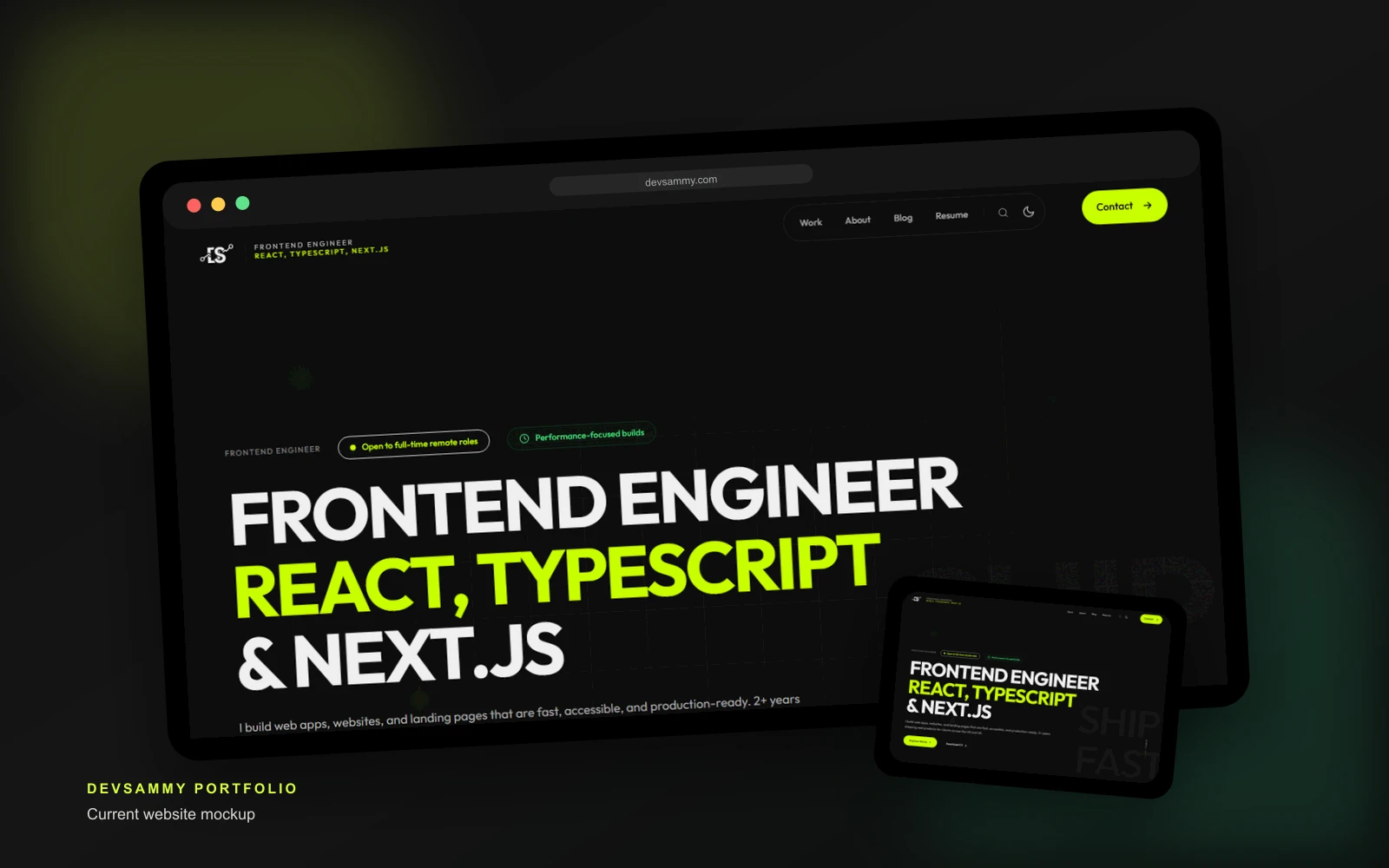
Overview
This portfolio is a technical project as much as it is a personal website. The goal was to build a site that demonstrates frontend judgment through the product itself. Instead of only listing skills, the site needed to show how I think about performance, content structure, responsive design, animation, SEO, and maintainable frontend architecture.
Because the portfolio is aimed at remote US and UK opportunities, the site also needed to communicate clearly to non-technical and technical visitors. Recruiters, founders, agencies, and engineering teams should all be able to understand what I do without digging through clutter.
Product Goal
The portfolio needed to act as a live proof point. If I say I care about fast, polished, production-ready frontend work, the website itself has to support that claim. That shaped the decisions around stack, content structure, animation, and page layout.
The site includes public marketing pages, project pages, blog pages, contact flows, and internal/admin-oriented features. It is built to feel like a real product rather than a static resume page.
Stack And Architecture
The site uses Next.js, React, TypeScript, and Tailwind CSS. Next.js gives the project a strong routing and rendering foundation. TypeScript helps keep data shapes clear, especially for project content, blog content, forms, and admin workflows. Tailwind CSS keeps styling close to the components while still allowing a consistent design system.
MongoDB and NextAuth are included for dynamic content and authentication workflows. The site is not only a visual frontend. It also has application-like pieces behind it, including content management concerns and protected admin functionality.
Frontend Design System
The visual direction is dark, sharp, and performance-focused, with a high-contrast accent color and large typography. The design is intentionally bold because the site needs to create a memorable first impression while still feeling focused on work.
Reusable sections help keep the site consistent across pages. Project cards, buttons, section labels, content layouts, and technology pills all follow the same visual language. That consistency matters because a portfolio with too many disconnected page styles can feel less professional.
Motion And Interaction
The site uses GSAP for animation, but the motion is designed to support the page rather than dominate it. Animation appears in reveals, hero moments, and section transitions. The goal is to make the site feel alive while keeping the interface readable and fast.
I also paid attention to interaction details such as hover states, card movement, button clarity, and navigation behavior. These small details help the site feel more complete and production-ready.
Content System
The project data is structured so case studies can include summaries, roles, technologies, images, galleries, and detailed markdown content. This makes the project pages easier to expand without redesigning the whole system each time.
The portfolio also supports blog and resource-style content, which gives the site room to grow beyond a one-page showcase. That matters for SEO, authority, and long-term professional positioning.
SEO And Routing
The site includes metadata, sitemap support, structured routes, and project slugs designed to avoid SEO conflict with client websites. Project URLs use neutral case-study language rather than directly competing with client brand names.
This is a subtle but important decision. A portfolio should benefit from showing client work without creating unnecessary search competition with the live client sites.
Result
The final portfolio is a working demonstration of my frontend process. It shows React and Next.js implementation, TypeScript data modeling, Tailwind UI systems, GSAP motion, MongoDB-backed features, authentication workflows, SEO thinking, responsive design, and practical content architecture.
What This Project Shows
This project shows that I can build more than isolated pages. I can structure a frontend product, organize content, think through SEO implications, polish the interface, and keep the codebase ready for future expansion.